| Blog |
Is your management team hesitant about engaging on social media. Would an exam on communicating with your customers on social help? Lego thinks so. The global brand has announced its team will sit social media exams after its development programme was so well received by its employees.
So much so that a one-day course, which concludes with practical and theoretical exams, was introduced to help managers get their heads around the importance of using social media as a form of communication to create a connection with its customers.
As part of the programme, attendees are tested on how well they can compose and post a message to appear on the company’s official Facebook page. No pressure then! For the social-savvy folk out there, this may seem a very simple task, but for those who have had very little need to familiarise themselves with this, or even engage with customers on social media, it may well fill them with fear.
Lego’s director of social media, Lars Silberbauer, believes “everyone in a company needs to get what it is to be social”. Without a social media presence that everyone in the company understands, brands may risk falling behind their competitors in terms of making the all-important brand-to-consumer connection in order to deliver the building blocks of an effective social business strategy.
In last Friday’s blog post, we looked at how the British Heart Foundation’s Rock Up In Red campaign had been received so far on social on the day of the campaign. People had been tweeting, posting Facebook comments and replying on forums in their thousands providing vital insight for the BHF to measure and analyse the impact of the fundraiser to increase awareness of heart disease.
We carried out a deeper analysis of the social conversation on social from 26 January to yesterday to gauge the overall social response to the campaign.
From the chart above you can see there was an increase in mentions in the run up to the campaign with the number of mentions peaking on Friday at 1,070. It may come as no surprise that after campaign day the number of mentions dipped, but overall the total number of mentions stood at 2,387.
We also analysed the sentiment. And, it’s good news for the BHF as there were few negative comments surrounding the campaign. From the pie chart it’s obvious that there were far more positive mentions accounting for 34.1%.
The majority of comments from social media users were announcing, or showing, what they were doing to fundraise for the charity, with updates on how much they raised towards the cause:
If outreach is part of your integrated social strategy, it is vital you know who your key influencers are to start building a rapport with your target group. By using a social media monitoring tool, you can identify the key influencers by authority or by mention. Mention refers to the number of times a specific social media user has talked about your brand whereas analysing by authority involves looking into the number of followers that social media user has.
As you can see above, after @BHF official Twitter account, the next two most influential tweeters by authority, with a score driven by their number of followers, were by @SoilAssociation and @MollieTheSats:
Both are already strong supporters of the charity. This was reflected by several tweets encouraging their followers to support Friday’s campaign.
In comparison, influencers by mention could well show very different results.
This influencer by mention chart shows just that! @Ngill01 was the winner by mentioning the Rock Up In Red campaign 136 times between 26 January and yesterday.
Buzz volume, sentiment and influencers are only a few functionalities that could be of use to charities wishing to monitor the reaction to campaign. If you work for a charity which has, or is looking to find out how a specific campaign has resonated on social, consider engaging with a social media monitoring tool like Sentiment Metrics, as it will help you measure and analyse the impact of the campaign easily and efficiently.
Content can go viral on social media channels like YouTube at the click of a button. Sometimes a brand can find itself at the centre of a viral campaign for all the wrong reasons, but with clever, innovative content, a brand can use the channel to drive engagement for all the right reasons.
For those of you out there who may be slightly apprehensive at the thought of producing your first YouTube social campaign, we have produced some tips for you:
First things first: Be brave and bold
Success on social media won’t fall into your lap. You have to work hard to make your campaign attract interest from a discerning audience. You probably already know that but the same applies to creating a viral campaign. Get in the right mindset. Don’t be scared to venture in pastures new!
Know your audience
To ensure the maximum reach possible, make sure the campaign relates to your target audience, and make sure you are networking with the right crowd to increase engagement. Chances are many of the people you know are in the same industry as you so they can be “powerful assets you can use when it comes to launching a viral campaign – it’s all about your contacts!”
Make people curious
TechCrunch advises to “Create something they will want to pass around.” You have to be able to keep the audience’s attention to motivate them to share or view it fully.
Using emotion is key
“Chopping and changing between uncomfortable humour and surprise works.” Bodyform is agreat example of this. A YouTube video, posted as a result of a Facebook message sent to their company account by a man named Richard, became worldwide news after their response called ‘Bodyform Responds: The Truth’ went viral receiving over 3.5 million views.
Stand out
The final element of any viral marketing campaign is its uniqueness. Your campaign must have an aspect of it which makes it memorable. Be innovative!
Case studies – Who’s been getting it right?
Samsung
Samsung’s 2012 advert for the Galaxy S III model has racked up 17,353,836 views on YouTube since it was uploaded. “The next big thing is already here” uses satire to make fun of the the rival iPhone 5 by making constant comparisons to Apple’s iPhone and taking the mickey out of those who queue for hours and sometimes even overnight to get their hands on the latest Apple gadget by showing people in different locations across the US in the run up to the launch of the product.
It’s not just businesses that seem to have got the knack of producing content that’s gone viral…
McFly
A hit video posted by a member of British pop group McFly also sent YouTube crazy, but most likely unintentionally! Tom Fletcher decided to take a rather unique approach when delivering his wedding speech by making up his own lyrics to previously released McFly tunes. The personal moment managed to receive 8,782,792 views within two weeks of the video being posted (Good going I think!). If your company can get that amount of success in two weeks, you know you’re on to a winner!
By taking on board the tips and examples above, you can see how, with a little imagination YouTube videos can go viral very quickly. If you are in the process of planning your next social campaign, and YouTube is part of your channel strategy, go on, break the mould!
After one year of dedicated work, the redevelopment of the Sentiment Metrics tool is complete! We were already awarded for ease of use and deployment in the enterprise, and on the back of some great enterprise wins we thought it was time for even more improvements in usability, power and cutting-edge functionality!
As one of the industry’s leading vendors for social media monitoring, we wanted to provide you with a quick summary of our new and improved user interface.
Configuration Tab
Our new wizard will help you to simplify your stream configuration. It provides an easy starting point when adding streams. There are two ways of doing this; either simply by clicking on the ‘+’ icon on the toolbar to the right of your streams or alternatively by clicking on the configuration tab. If you choose to click on the configuration tab you will see the screen below:
Within the Sentiment Metrics solution, you have the opportunity to see a live preview of sample mentions in the lower half of the configuration screen before adding a stream to refine it, if required. As you add key words / phrases the live preview will update.
Another type of configuration you can use is for Facebook pages. Account holders typically use a specific URL to monitor a Facebook page. The system will run an analysis on that individual page rather than more broadly with key words / phrases.
Once you’ve finished entering the stream criteria, whether it’s via the wizard, a manual entry or for a Facebook Page, don’t forget to hit the add icon. This will automatically save the stream and immediately start retrieving mentions from millions of online sources for the past 30 days. We also have an archive of 30 billion mentions which we can search for you, so don’t worry – whatever your data requirements Sentiment Metrics has it covered for you!
Analytics Tab
Depending on your social media monitoring objectives, you may wish to limit the results to certain specifications such as region, channel, age etc. The all-new drag and drop function allows you to include or exclude specific filters at the click of a button. This has been introduced for ease of use and to allow each user to find specific data quickly and more accurately.
Let’s take regions for example. From the chart below you can see that mentions from the UK and the US have been included but other countries have been excluded:
Once again, live loading of data in your sub search will appear in the bottom half of the screen.
Custom Analytics Tab
As you’ve seen above, whilst Sentiment Metrics already had strong analysis capabilities, the system also has a flexible custom analytics section. Power users can create sophisticated non-standard reports which can be saved either for future use themselves, or to share to other non-technical users as read-only reports. Sentiment Metrics custom analytics can answer those questions which require a greater level of analytical flexibility, such as “what are the key topics being discussed by women aged 26-40 across the UK towards your industry term, and which of these topics are of positive sentiment and which are of negative sentiment?”
For example, as you can see above, you could look at the top topics for a stream, select one of them, such as ’social media monitoring tools’, and then drill down to see the sentiment of that specific phrase.
Reporting Tab
This area of functionality has been completely developed from the ground up providing the most powerful report builder in the industry. The reporting function of the tool allows you to schedule daily, monthly reports to be sent out to certain email addresses at a time of your choice.
You are also now able to select the charts you would like to include in the PDF report. Even better – these are unlimited, so you can go crazy with the number of charts if you like! You can drag and drop your chosen charts into the report template…
…as well as having the opportunity to re-order them if you wish under the report contents column on the right hand side. Again this is a drag and drop function:
This column can also be used to delete charts from the PDF report by clicking the ‘X’ icon, and drag and drop to reorder the contents, you can also add your own custom notes and logos!
Engagement Tab
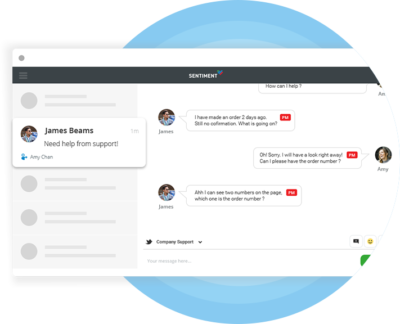
Engagement is the second section which has had a significant revamp. Designed in partnership with an award-winning contact centre, the engagement function is a standard part of all accounts (with no extra charge), as is unlimited user accounts so feel free to socialise the enterprise!. As it is fully integrated into our social intelligence solution there’s no need to refresh as data is pushed to the user interface in real time, resulting in live streaming of mentions for you to have the opportunity to reply to. You are able to directly respond to tweets and Facebook posts within seconds of them being posted, saving the hassle of having of having to flick between different tabs on your computer screen (a nice touch don’t you think?!).
The functionality includes live broadcast as well. So if two members of the team are viewing a data stream, and one user clicks to reply, the other user will immediately see this mention is locked, they will also see comments, tags and assignments in real time. A great collaboration tool!
This is just an overview of what we have to offer in Version 3 and there’s more to see and even more to come! We recommend you try it for yourself so you can understand just why 400 leading brands and agencies have chosen Sentiment Metrics for their social media monitoring and engagement requirements.
Sports and social media are a great pairing. As millions of fans enjoy the action, social media can bring them all together in a way never before possible.
This new infographic (below) from Eventility has identified some fascinating stats on the subject, some of which came as a bit of a surprise.
Although it was no surprise to see football (soccer) dominate the lists of most popular teams and players, the complete lack of US dominated sports was more of a surprise. Baseball and American football do not appear anywhere in the top 10 for Twitter or Facebook.
The infographic also shows how social media monitoring can be used to track the buzz surrounding events. For instance, the London 2012 Olympic’s generated 50 million tweets and last year’s Super Bowl generated 13.7 million tweets. Of course, it is possible to measure much more than buzz volume. These tweets can offer event the organisers, sponsors and competitors valuable and actionable insights into a wide range of issues.
For instance, which advert generated the most buzz during the Super Bowl? Which brands were most heavily associated with the Olympics? If a sports brand is looking to sponsor an athlete, they will want to measure the amount of social buzz around them as well as the sentiment. The venue will want to know what attendees thought about the refreshments, the prices and the parking. Social media monitoring can offer useful insights into all of these things and much more.
One thing that’s clear from this infographic is how effective events themselves – including sporting events – are at generating both buzz and followers, and how important it is to seize the moment.
This is a guest post from Jeremy Taylor – Community Manager at Our Social Times. Next week Our Social Times are hosting a free webinar on Monitoring for Social Customer Service.
On Tuesday night, many people tuned into Channel 4’s documentary Don’t Blame Facebook. The programme looked into the repercussions faced by several UK based tweeters and Facebook users after making various online ‘fails’ on social networking sites. As lovers of all things social, we were intrigued to see what people were saying about it online.
By using the Sentiment Metrics social media monitoring tool, we had a look into the chat around the show over the past three days, to see how it had been received. From the chart above you can see that there was a peak in mentions on Tuesday at 2052.
The response to the programme was mixed. On a positive note, it looks like the documentary did its job. By analysing the mentions, it would seem the key message of the program was apparent. People were starting to think twice about what they will tweet or post on Facebook in the future:
However, it also triggered a lot of satire amongst social media users:
Others either thought the response to social media content was too extreme, or pointed out individuals only had themselves to blame for what they said on social in the first place.
With an increasing number of online faux-pas being reported, and social media becoming more prominent in business strategies, next time you are posting a comment on any of your brand’s corporate social media pages, pause for a moment and make sure you get it just right!
Is it really that time of the year again already?! A new year, a new start … and all that jazz. Statistics show that social media will be more important than ever for brands this year. Social Media Today reports that, according to research from Mass Relevance, 59% of consumers are more likely to trust brands that have established a solid social media presence.
So, if you are planning to use social media for engagement this year and need a little motivation, here are some handy tips on getting started:
(Image from: http://www.bbc.co.uk/news/uk-england-london-20880275)
- First things first: Define your social media objectives. To get the best out of your social media investment, clear objectives should be set from the word go. For example, which channels are you going to focus on? What are you looking out for? A recent report by eMarketer found that ‘Facebook is the number one social site for consumers to share product information with their networks.’ Something to keep in mind…
- Be unique. It’s ok to stick out from the crowd, if it’s for the right reasons. A lot of people will be drawn to a brand if they are different and produce innovative content.
- Know your audience. By doing this, you are more likely to attract, and engage, your target audience.
- Don’t be afraid to reach out! One of the key elements of influential social media engagement in building social relationships. These may not always land in your lap so be prepared for search for them.
- Be social and build rapport. Most people won’t want to be bombarded with salesy jargon.
- Lastly, don’t ignore negative mentions! As I’m sure many of you will agree, it’s not nice hearing negative things about your brand but you will never be able to please everyone. Therefore, it is essential that you take any negative comments on board. With some deft footwork, negatives can also be turned into a positive.
This is just a short list of tips to help you start 2013 with a bang. And, nudge, nudge, subscribing to a social media monitoring tool should also be at the top of the list to help you increase customer engagement. After all, ‘75% “are already talking about brands on social media channels.”’ Are you listening?
Every year brands compete during the festive season and this year has been no different, apart from the number of companies incorporating social media into their Christmas campaigns. One brand to do just that is Toys R Us.
The retailer wanted to produce an interactive social campaign ‘aimed at getting the whole family involved and is a simple yet effective way of getting people involved on board and engaging with the brand.’ And, its Facebook campaign has been a big hit with consumers.
The brand’s festive social media campaign, which was introduced in November, already has 90,000 likes and is constantly growing. Social media users are being encouraged to upload a picture of their family to its Big Family Album Facebook page. By doing this, fans are entered into a competition to have their family photo appear in the company’s Christmas advert. And, to boot, Toys R Us is offering Facebook users the chance to come up with catchy captions for images posted from the company account.
This is all well and good, but some of you may be thinking why is social so useful when producing these types of campaigns? The answer is: outreach.
Using the Sentiment Metrics tool, we looked at the sentiment surrounding the social campaign, from the beginning of November up until today, to gauge how this form of social outreach impacted social media users.
From the chart above, you can see that it received a warm reception, with 51.9% of the mentions having a positive sentiment.
Toys R Us may cater for children, but businesses can learn by the example set by the brand. By getting the whole family involved at a time of the year which encourages family time, you could be well on your way to a successful social media campaign, improved engagement and brand awareness. And, potentially an increase in sales – social recommendations are proving vital in increasing much-needed sales on the high street.
The point to take away here? When launching a social media campaign, always know your audience and you shouldn’t go wrong!
Social media monitoring is an increasingly important activity for any large organisation, but choosing a monitoring tool is a difficult decision. To help identify the key factors and questions to consider, Our Social Times recently hosted a fascinating webinar on what to look for in a social media monitoring tool.
For those that couldn’t make it, you can listen to the recording here or read on for a summary and key takeaways.
On the panel was our own Leon Chaddock, joined by Nathan Gilliatt from Social Target and Matt Rhodes of Fresh Networks. Asking the questions was Luke Brynley-Jones from Our Social Times.
We kicked off the webinar by discussing how social media monitoring has evolved in recent years.
First of all, the sheer number of monitoring companies has changed dramatically. Just a few years ago there were only a handful to choose from, whereas today there are hundreds.
The purpose of social media monitoring has also changed. Originally it was marketing and PR that were interested and the primary goal was crisis prevention. Nathan described it as defensive and ‘usually framed around scare stories’.
Today however, PR and marketing are just a small part of the picture. Social media monitoring is widely used by multiple departments, whether it’s to show senior executives what customers are saying about them, product development, or perhaps most prominently, customer services.
Customer service was one area picked up on by all speakers. It’s no longer a simple case of preventing crisis, teams are proactively using social media monitoring to resolve customer issues.
What’s the first question you should ask yourself when choosing a social media monitoring tool?
What are you trying to accomplish? Although it seems obvious, it’s a bigger question than you might think and the conversation ultimately involves multiple departments. Everything else depends on your answer to that question!
It’s no use saying “I want to offer good customer care”. You need to get specific and look in detail about how you will do this, who will do the work, and what is possible.
As part of this process, you will no doubt come up with further considerations. For instance, Matt Rhodes spoke about a client he has in the US, where it is very important to monitor in Spanish as well as English.
Leon also urged us to think about the type of data you care about. Some companies are only interested in their own Facebook Page, others require access to the full Twitter firehose and some are more interested in monitoring blogs, news sites or forums. It’s not only the amount of data available, but also how quickly you can drill into it to identify useful and actionable insights.
What are some other core features you’ve got to have as part of your monitoring package?
There are some features that all monitoring tools will have, such as sentiment. You need to look beyond this, what do they actually do with the data? For instance, do they provide detail on demographics or offer influencer analysis?
There’s also the front end to consider. As Nathan pointed out, visuals should not be your top priority, but it could make the difference when trying to convince your board to cough up the budget.
What kind of skills do you need to set these things up? Do you need an analyst or is self-serve ok?
Nathan drew on his experience to suggest that more often than not, you will need an analyst. Setting up queries, drilling-down into results and creating reports has to be done manually. The question is, is that person from the vendor, an agency, or one your staff?
Matt pointed out that when a client is unhappy with a tool, this is often because they haven’t spent the time and effort to configure and set things up properly. If the vendor can offer an in-house analyst, you will get more out of the tool.
Looking at our own clients, whether they require an in-house analyst is largely dependent on the size of the organisation. For example, Leon mentioned a UK bank for which we set up systems for 7 different departments and provide regular insights reports. On the other hand, self-service may be ok for some smaller businesses.
There’s a useful test to help you assess ease of use – ask two different users to try a tool and report back on it and often they’ll come back with two completely different reports.
Do you think the amount of human labour required to get actionable insights will increase or decrease over time?
The panel unanimously agreed that it would decrease. Given the effort vendors put in to making things work better, we should expect to see automation improving over time. Leon also suggested there will be a change in what we actually look at. For instance, we will stop looking at sentiment and instead analyse intention.
Leading on from this, Luke asked if sentiment detection and analysis really matters.
Matt suggested that sentiment is very useful, but not if you only look at it at the basic level. You need to break down what is being discussed. For example, what are people saying specifically about your staff? Then drill down even further to see what people are saying about staff in one area and how this compares to another. You need to keep breaking down the data to get truly actionable insights.
Where do you stand on human vs. automated sentiment?
Although Nathan claimed to be a big fan of automating anything that can be automated, he accepts that this is particularly difficult with Twitter. After all, if humans struggle with sarcasm and irony how can we expect computers to cope?
Despite this, Leon was keen to point out that automated sentiment definitely has its place. It can identify trends and extremes in sentiment and email alerts can let you know of any spikes or swings immediately. When it comes to reporting, it is still important that human analysts can override sentiment.
Another question to ask is if you vendor offers human analysis, who is doing that analysis? Often it is done in cheaper locations overseas where they may not be native speakers.
Where do we sit on influencer analysis?
There’s no denying that this is an important but controversial area. As far as Sentiment Metrics is concerned, we want this to be transparent. Rather than awarding a meaningless score without explaining its meaning or how it’s measured, we let users decide what to look for. This could be a Klout score, or they can get more specific.
What aspects of team working would you expect to see within a platform?
Workflow is incredibly important for teams using social media, especially if it’s for customer services. What you’re effectively looking for is a ‘light CRM process’. Can you automatically assign things to individuals or groups? Can you assign tasks to yourself? Is there a place to track notes internally? Can you re-assign to someone else? Are there notifications to remind them?
Leon discussed how we’ve been working with a contact centre to develop our system. The last thing you want is to be able to click a tweet and start engaging with it without anyone else knowing about it. You need to see what your colleagues are doing in real time or you’ll end up with two people replying to the same tweet with completely different responses.
Nathan also reminded us that in social media, it’s very trendy to say “it’s not about the technology, it’s about the people”, but when you’re selecting the technology it is about the technology.
Are there certain things you need to look for in terms of reporting?
Matt argued that if there is one area of monitoring when human involvement is required, it’s reporting. You know what you want to show and you will want different reports for different people. You’ll never find the perfect solution off the shelf and therefore they need to be customisable. The best reports are when the brand / agency work together with the provider.
What should you pay for a monitoring tool?
Of course, it depends on the size of your company. If you’re an SME there may be benefit to using a free or cheap tool, but you get what you pay for. If you’re an enterprise, you need an enterprise grade tool. For some, this will mean spending £1000+ p/m. Matt even let us know about a client of his that spends £1 million a year on monitoring. That said, spending hundreds rather than thousands a month is adequate for most!
It was great to be a part of this fascinating webinar and we look forward to doing some more in the future. The full recording is available here.
Our next webinar will be in January and will look at social customer service. You can register here to be a part of it.
As Remembrance Sunday gets closer and poppies wreaths are laid out at the foot of memorials, we must not forget the real reason behind Remembrance Sunday. This day celebrates the lives of fallen and serving members of the Armed Forces.
The Royal British Legion is hoping to extend awareness of the national day to a new level; with a campaign involving social media which targets the younger generation who are less likely to observe the silence.
The charity is aiming to get 43 million social media users to freeze their online social activity for two minutes by sending out a Thunderclap. The Royal British Legion is the first UK charity ‘to embrace the American technology … which allows social media users who have opted to take part to send a simultaneous Tweet or status update.’ Social media users have to sign up, with the charity pledging to send out another message for each person who signs up at 9am on Sunday morning. They should then post the following message: ““I won’t forget to Remember on 11.11.11 Will you? #2MinuteSilence”
Using the Sentiment Metrics tool, we looked into the buzz created on social since the day before the campaign launched on 5 November. Since then, 2,486 people have used the #2MinuteSilence hashtag which has been at the forefront of the digital campaign. This number is set to increase as the day gets nearer and word spreads further.
It is also hoped that this will be the first time people come together on social as well as in real-life to pay their respects. Richard Branson and Ricky Gervais are just two of the well-known names supporting The Royal British Legion this year by tweeting:
This is another great example of how social media can build awareness and it will be interesting to run an analysis after the weekend to measure the reach of the Royal British Legion campaign. In the meantime, will send your Thunderclap?